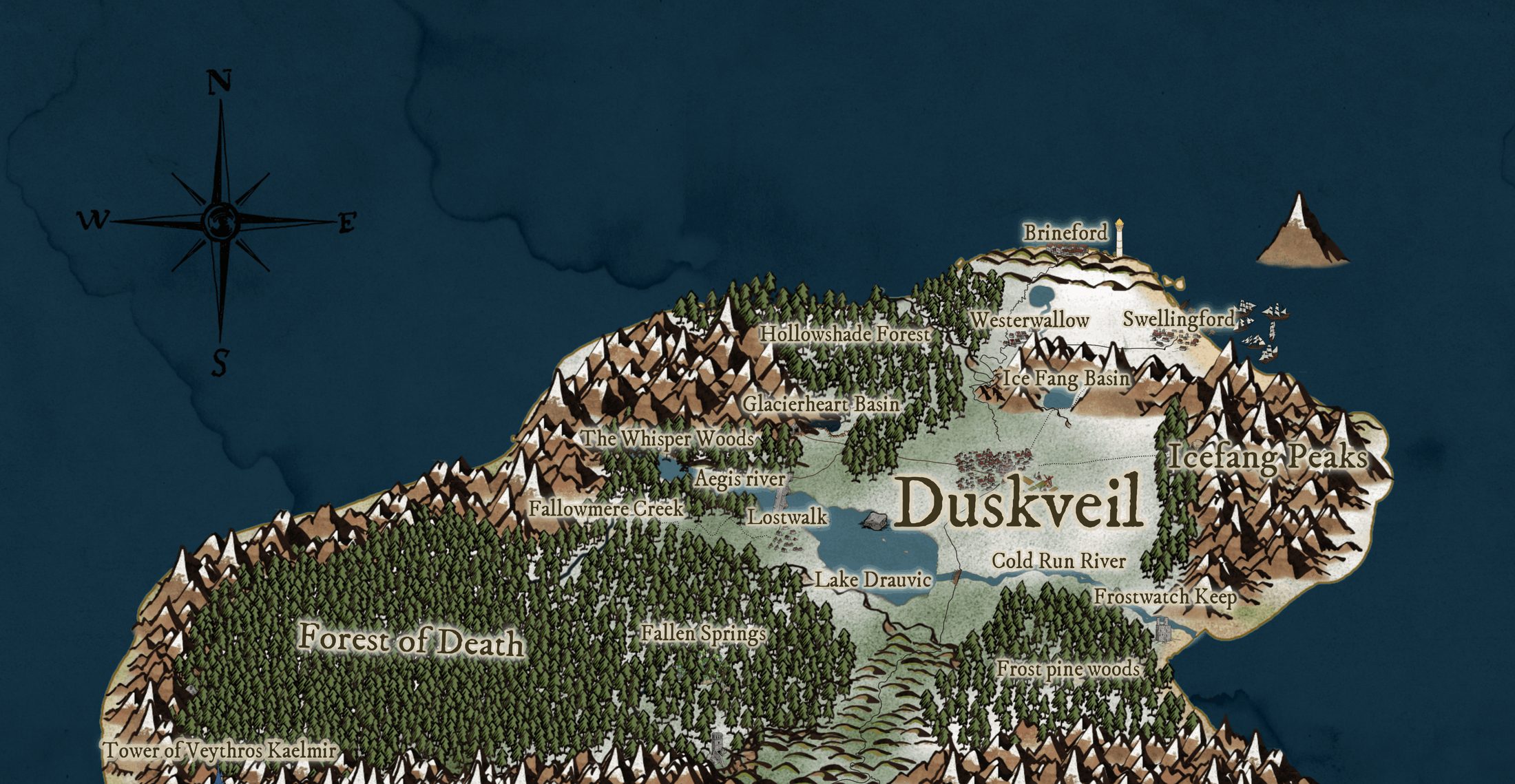
Duskveil and the northern territories · tap to enlarge
From the writings of Historian Calvess Marrin, 42nd Year After the War's End
Duskveil is a kingdom built on magic. For generations, its citizens have been born with minor, innate talent, a quiet inheritance from the ambient mana radiating from the Forest of Death to the west. Most Duskveil folk know at least one or two cantrips, and magic is woven into daily life. Here magic is a tool, not a weapon: prestidigitation keeps the streets clean, eldritch blast carves sewers and stone, mending holds the city together.
The streets are orderly, the architecture uniform, the air thick with quiet spellwork.
Faith
Faith in Duskveil is quiet, personal, and unspoken. There are no grand temples, no state-sanctioned churches, no public rites conducted under royal authority. The gods are not forbidden, but neither are they encouraged.
The absence of organized religion is not recent. It traces back to Duskveil's founding, when the early rulers looked eastward to the Icefang Peaks and saw Vraxxilaurithar, a being of immense and undeniable power. The question arose among those first generations: why worship distant, silent gods when a creature of near-divine might dwells within sight?
Small shrines exist in homes and hidden courtyards, tended by the faithful in solitude. Bards, Clerics and paladins, though rare, are integrated into the city's law enforcement. Their divine gifts, spells of truth, wards against deception, oaths binding in ways arcane magic cannot replicate, are valued tools in the pursuit of justice. The state does not care whether their gifts stem from divine favor, arcane study, or natural talent. It cares only that they work.
The faithful pray in private. The pragmatic govern in public. And the state, indifferent to both, continues as it always has, through arcane power, strict law, and the certainty that what is seen can be trusted more than what is not.
Justice & Law
Justice in Duskveil is not a spectacle. There are no public trials, no arenas where guilt is determined by combat, no crowds gathered to witness sentencing. The accused are brought before authority in private chambers, their fate decided swiftly and without ceremony. The system values efficiency over display, certainty over debate.
For minor crimes, punishment is typically swift. Offenders may be fined, flogged in the barracks yard, or subjected to a practice unique to Duskveil: illusion magic shaming. A minor cantrip, cast by a guard or low-ranking mage, projects glowing text above the offender's head for a period of twenty-four hours. The text identifies the crime. THIEF, VANDAL, DRUNKARD, and follows the individual wherever they go. The spell is harmless but effective. Social pressure, rather than incarceration, serves as the primary deterrent.
For crimes of greater severity, arson, burglary, forgery, fraud, violent assault, trials are conducted in private within the palace, with the King's final approval required for all sentences. Magic compels truthful testimony. Resistance is taken as evidence of guilt. The guilty are condemned to long-term civic labor, sentences spanning years or decades. The labor is grueling. The state derives value from their work, and so they are kept alive as long as they remain useful.
The Problem of Magical Criminals
A mage capable of casting spells can escape, kill their guards, or destroy evidence with ease. To counter this, Duskveil employs Iridium shackles, manacles forged from a rare mineral mined in the Icefang Peaks. When worn, these shackles drain all ambient mana from the prisoner's body, rendering them incapable of casting even the simplest cantrip. The effect is absolute. The exact number of shackles in Duskveil's possession is not publicly disclosed, though the Crown assures the populace that supplies are sufficient to meet any need.
The Crime of Artificery
Among all offenses, one stands apart: the practice of Artifice. Following the Duskveil Wars, the Three Kingdoms, Duskveil, Grimfall, and Velgrada jointly decreed the eradication of all artificers and their works. The purge was systematic and brutal, though never formalized in open law. Those found in possession of artificer tools, blueprints, or completed devices were executed without trial. Workshops were burned. Apprentices disappeared. In Duskveil, the crime of Artifice is treated as a capital offense on par with treason. The last verified case of an artificer operating within Duskveil was recorded in 10 AE. Whether this reflects the success of the purge or merely the caution of those who remain is a matter of speculation.
Military & Defense
Since the end of the Duskveil Wars, the kingdom has maintained a policy of universal military obligation. All citizens of fighting age must serve a minimum of five years in the military. The requirement is enforced through civic audits and registry checks, with only the royal family exempt from service. Wealth and social standing provide no escape from this duty.
The Combat Division comprises frontline soldiers and battle-trained spellcasters. Training emphasizes both martial and arcane combat, with soldiers expected to wield magic as readily as weapons. The Support and Logistics Division handles supply lines, infrastructure maintenance, and arcane utility.
Duskveil's military does not seek expansion or conquest. Its doctrine is defensive, focused on maintaining the security of the city and its territories.
Regions & Territory
Duskveil's territory stretches across the northern reaches of Atheron, a harsh and unforgiving land defined by mountains, forests, and bitter cold. Beyond the corridors of civilization, the wilderness remains vast, dangerous, and largely unexplored.
Duskveil City
The city of Duskveil lies inland, protected by walls and positioned to control access to the interior territories. Population within the city proper is estimated at twenty-five to thirty thousand, though the famine years reduced this number significantly and recovery has been slow. The upper districts house administrators, mages, and those wealthy enough to afford proximity to the palace. Two stone fortresses dominate the Iron Quarter north of the slums, housing the kingdom's long-term prisoners.
Icefang Peaks
The jagged mountains to the east rise like teeth against the sky, their peaks perpetually shrouded in snow and storm. The range is home to the ancient dragon Vraxxilaurithar said to dwell in the highest reaches where no mortal can survive for long. Whether the dragon still lives or has retreated into legend is a question few dare investigate. At the mountains' base, extensive mining operations extract iron, coal, bronze, and Iridium, the rare mineral used to forge the shackles that contain dangerous mages.
Frostwatch Keep
South of the Icefang Peaks stands Frostwatch Keep, a fortress guarding the eastern coastline. The keep is garrisoned by approximately eight hundred soldiers, supplemented by mages specializing in defensive wards and long-range combat spells. Its position ensures that no force can move south from the peaks without passing under its watch.
Westerwallow
Forty miles north of Duskveil, Westerwallow is a village of approximately five hundred residents who subsist on fishing the alpine lake and foraging the western woods. The alpine lake is known throughout Duskveil for disappearances. Divers vanish without trace, their bodies never recovered. Some believe a creature dwells in the depths. Others speculate cave systems beneath the lake trap those who venture too deep. No one knows for certain.
Swellingford
Swellingford is a coastal town of roughly one thousand, its population inflated by military presence. Fishing in Swellingford focuses less on food and more on oysters, clams, and the pearls they might contain. Occasionally, divers retrieve stranger things, objects swallowed by the sea, origins unknown.
Brineford
The smallest of the northern settlements, Brineford houses approximately three hundred villagers. A lighthouse guides Duskveil's fleet and trade vessels between the mainland and a landmass twenty miles east. Fishermen catch strange specimens from the northern waters, and sailors tell stories of sea monsters lurking beneath the waves, but little disturbs the village's peace.
Frostpine Woods
South of Duskveil lies the Frostpine Woods, a vast forest shrouded in snow and silence for much of the year. Travelers describe creatures whose behavior suggests intelligence and intent, luring rather than hunting, drawing victims deeper into the forest before contact ceases. Few who enter the interior return, and those who do often refuse to speak of what they encountered. Accounts describe sounds that mimic voices, paths that seem clear yet lead nowhere, and the sensation of being watched by something that remains just out of sight.
Hollowshade Forest & Glacierheart Basin
The Hollowshade Forest serves as a training ground for Duskveil's military, used primarily for winter survival exercises. Those who survive Hollowshade are considered competent; those who underestimate it do not return. South of the forest, the Glacierheart Basin cradles an alpine lake fed by glacial melt. The basin is home to a mine rich in gold, silver, and diamonds. The wealth extracted from Glacierheart has funded much of Duskveil's recovery from the war.
Lake Drauvic & Lostwalk
Lostwalk sits between Lake Drauvic and the Aegis River, a modest town of approximately six hundred inhabitants. The town was destroyed during the Duskveil Wars, burned during Grimfall's advance, and left abandoned for years. Reconstruction began in the war's aftermath, and Lostwalk was one of the few settlements to be fully rebuilt. Its recovery is cited as evidence of Duskveil's resilience. On rare occasions, sea creatures from the Cold Run have been reported as far inland as Lake Drauvic.
The Aegis River
The Aegis River is one of the most dangerous waterways in northern Duskveil. The river's violent currents and deep undertow make passage treacherous even for experienced swimmers. Drownings occur several times each year, and the bodies are not always recovered.
Whisperwoods and the Vanished Settlement
The Whisperwoods lie north of the Aegis River, a region of dense forest and unsettling quiet. In 39 AE, a small elven settlement north of the woods vanished without trace. A formal investigation by the Duskveil Crown found no remains, no signs of struggle, and no residual magic. The silence of the area was described in official reports as "unsettling and complete." Whether the disappearance was natural, magical, or the result of deliberate action remains unknown. The woods are now marked on maps as dangerous territory to be avoided.
The Forest of Death
West of Lostwalk, the Forest of Death sprawls beneath a ring of mountains forming a rough crescent to the west, north and south. The forest is named for good reason: expeditions into its interior rarely return intact, and those that do report creatures stronger, faster, and more aggressive than their counterparts elsewhere. An invisible boundary appears to contain the forest's dangers, preventing them from spreading beyond its edge. Adventurers who venture within do so without official support, and rescue efforts are not attempted for those who fail to return.
Fallen Springs
South of Lostwalk and west of the Frostpine Woods lies Fallen Springs, an elven city built among the trees. The settlement is home to approximately one thousand elves, a population diminished from over two thousand before the Duskveil Wars. Though Fallen Springs lies within Duskveil's territory, the elves remain autonomous under a pact with King Tharion: they govern themselves independently so long as they answer the crown's call in times of war. This arrangement has held for decades, and the elves have honored it without fail, though the cost during the Duskveil Wars was devastating.
Public Figures
King Tharion Duskveil
Appearance: Long grey hair worn in a middle part, falling to one side. He looks very old, yet still carries an aura of strength. His skin is pale and wrinkled, and his bright blue eyes seem to see everything.
King Tharion Duskveil has ruled for decades, presiding over both the catastrophic Duskveil Wars and the difficult recovery that followed. He survived the Siege of Duskveil when the dragon Vraxxilaurithar descended from the Icefang Peaks and shattered the Grimfall host, though the exact circumstances of the dragon's intervention remain a subject of speculation. Tharion is known for his intolerance of incompetence and his swift judgment of those who violate Duskveil's laws. Public appearances remain frequent enough to dispel rumors of illness, but the King's demeanor has become markedly colder.
Princess Vaerra Duskveil
Appearance: Striking, dazzling eyes of blue shading into violet. She wears an almost constant calm, serene smile. Her clothing is dark, fitting the stereotype of a necromancer, and in public she wears a crown of dragon scales marking her as next in line for the throne. She is often trailed by an undead thrall to help normalize necromancy.
Princess Vaerra Duskveil is the eldest child of King Tharion and has been formally declared heir to Duskveil's throne. Vaerra is an accomplished mage specializing in necromancy, a school of magic that carries cultural stigma in Duskveil due to memories of the Famine Years. Her public defense of the practice is pragmatic: if Duskveil wastes nothing of the living, she argues, it should not waste the dead either. Whether she will prove a capable ruler or a dangerous one remains a question her father's court quietly debates.
Queen Seralyne Duskveil
Appearance: Strikingly youthful for her age, some say she could pass for Princess Vaerra's older sister. She has violet eyes and stands as tall as Tharion, with elegant posture whether standing or seated. She always wears a brilliant amethyst amulet and robes of bright or deep blue.
Queen Seralyne appeared in Duskveil shortly after the death of King Tharion's first queen. A sorceress of considerable skill, she claims descent from distant isles to the east, though details of her origins remain vague. Seralyne is a figure of fascination and suspicion in equal measure. Some praise her for bringing stability to the royal household during difficult years. Others distrust her foreign lineage and the speed with which she secured her position.
Ron Pyrehart
Appearance: Broad-shouldered and weathered from years of service, his once-black hair now streaked with gray. He's known to wear his guard captain's plate even off duty, as a symbol of vigilance.
Ron Pyrehart commands Duskveil's military forces and City Guard, a position he has held for nearly a decade. Orphaned at age seven during the Duskveil Wars, he enlisted at fourteen and rose through the ranks over three decades of service. Pyrehart possesses no magical ability, a rarity among Duskveil's leadership. He has compensated by developing expertise in countering spellcasters through disciplined tactics and enchanted equipment. His loyalty to the Crown is unquestioned. Though some whisper he is naive in the darker workings of politics, the rank-and-file guardsmen see him as both protector and exemplar.
Magister Halven Duskveil
Appearance: In his late forties, with salt-and-pepper hair kept in a bun. Of average build and height; his true power lies in his magic. He always carries a book in one hand, slowly and methodically fiddling with its clasp, not out of nervousness, but habit.
Magister Halven oversees all magical policy, research coordination, and the management of Duskveil's considerable spellcasting community. A distant cousin of the royal family, he holds his position through demonstrated expertise rather than proximity to the throne. The Magister is known for his curiosity and thoroughness. He pursues lines of inquiry with persistence that borders on obsession, particularly regarding historical mysteries and unexplained magical phenomena.
Wren
Appearance: In his forties but looks to be in his thirties. Tan-skinned with black curly hair and bright blue eyes, he has a muscular build and carries an air of nobility, which many attribute to his twenty-plus years serving the crown as court jester.
Wren serves as Duskveil's court jester, a role he has held for as long as most can remember. Known for biting wit and sharp perception, he mocks nobles and adventurers alike with impunity, somehow avoiding punishment that would befall anyone else who spoke so brazenly. His commentary is infamous for cutting close to uncomfortable truths. Among the common people, Wren is both loved and feared. He moves freely through the palace, speaks with guards and servants as easily as with nobles, and seems to hear everything worth hearing.
Selvine Marr
Appearance: An elf with long dark hair falling to her waist, her pointed ears peeking through. She has dark skin, full lips, and a small nose set with dark brown eyes. She favors form-fitting dark green robes that stay immaculate no matter the state of the rest of her.
Selvine Marr holds two significant positions within Duskveil: she oversees the Royal Histories and commands the city's branch of the Adventurers' Guild. Her rapid rise is unusual, achieved through demonstrated competence as an adventurer before her appointment to these roles. Selvine is a druid, a practice that has become rare in Duskveil since many elven druids perished during the war. Those who crowd her or make unwelcome physical contact may find themselves briefly transformed into harmless animals, a warning delivered with magical precision.
Crest & Meaning
The dragon honors Vraxxilaurithar the ancient Dragon whose intervention turned the tide during the Siege of Duskveil. Its silver body upon a purple field reflects the arcane authority of the city, while the frost recalls both the dragon's might and the kingdom's cold arcane order. The broken golden crown symbolizes Duskveil's rejection of foreign faiths and dynasties, asserting its supremacy through arcane power rather than divine or imperial claim.