Velgrada

They do not proclaim this greatness loudly, they simply assume it.

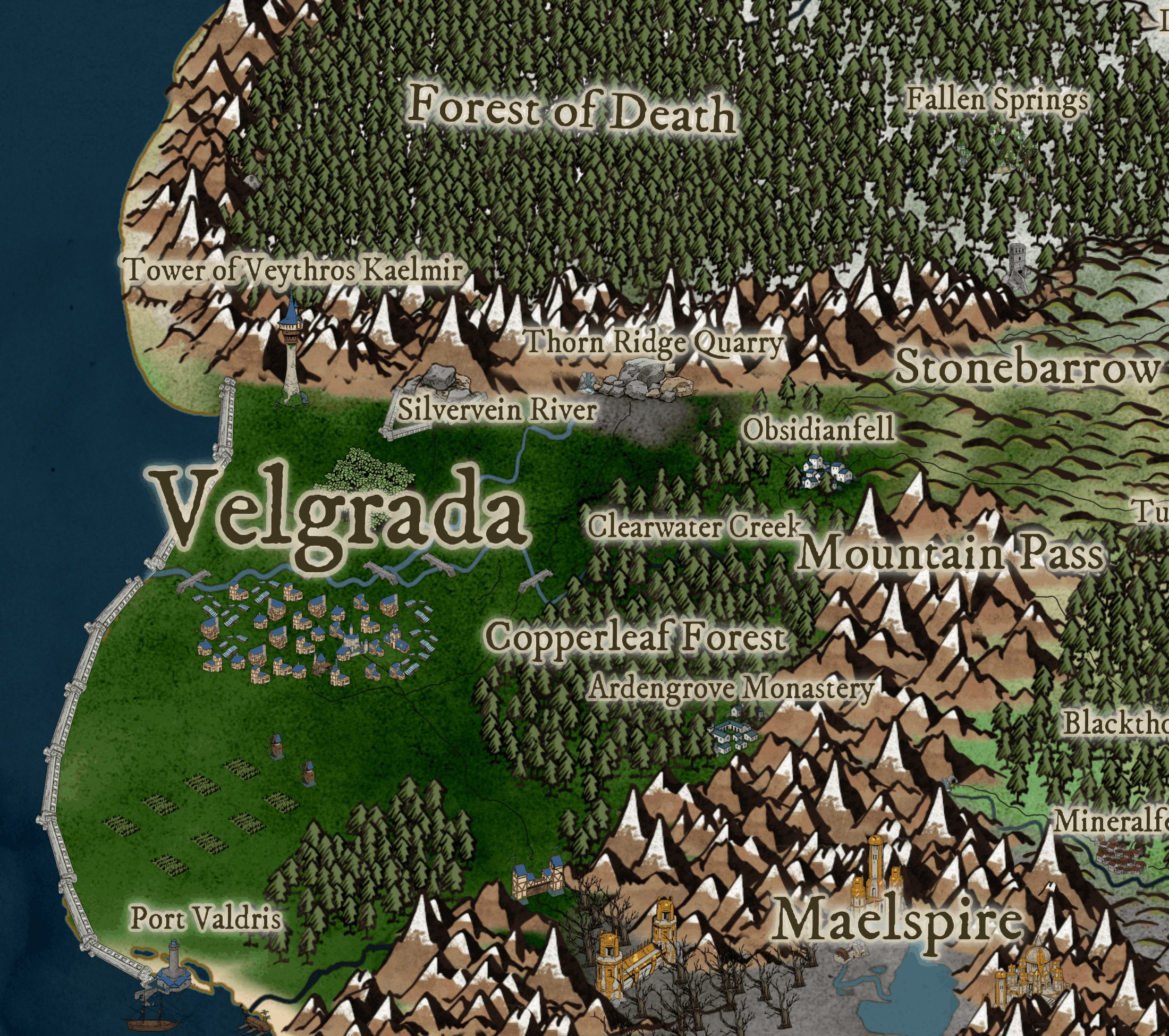
Velgrada and the western territories
Velgrada and the western territories · tap to enlarge

From the writings of Historian Calvess Marrin, 42nd Year After the War's End

Velgrada is a city defined by wealth, pragmatism, and an unshakable belief in its own superiority. Where Grimfall builds its strength on faith and industry, and Duskveil on arcane order and law, Velgrada thrives on commerce and the cold logic of profit. Its neutrality during the Duskveil Wars was not cowardice but calculation. While the great houses bled themselves dry, Velgrada's ledgers grew heavy with coin. That both kingdoms now view this pragmatism with suspicion is, to the Velgradans, merely proof of their rivals' shortsightedness.

Decoration is earned through skill, not purchased through excess.

The Council of Twelve and the Crown

Velgrada's government is neither monarchy nor republic, but a carefully balanced hybrid designed to prevent the concentration of power while maintaining stability. At its heart lies the Council of Twelve, a hereditary body of merchants and specialists who hold true authority over the city's affairs. Above them, though some would say beside them, sit Queen Illyenne Velgrada and King Consort Marenthal Vosk, whose power is real but constrained by design.

The twelve seats are divided: six belong to merchants whose families control Velgrada's most vital trades, and six to specialists who manage the technical functions of governance. The monarch is chosen by vote rather than bloodline. Once elected, a monarch can only be removed by unanimous vote of all twelve members, a threshold so high that it has never been achieved.

The Double Key System: Velgrada's treasury requires two keys to open, one held by the Crown and one held by the Council. Neither the Crown nor the Council can access the reserves alone, forcing cooperation in financial matters. The Double Seal Law: For a proposal to become law, it requires nine of twelve Council votes and the Royal Seal. If the Crown refuses to sign, the Council may override with eleven of twelve votes within fourteen days. Royal Bans: In times of emergency, the Crown may issue temporary decrees that take effect immediately and last thirty days. These bans expire automatically unless ratified by eight of twelve Council votes. Recusal: Council members must recuse themselves from votes that directly benefit their own house or trade.

This system has kept Velgrada functional where rigid monarchies have calcified and pure councils have devolved into bickering. It is not loved, but it is respected. It is not fair, but it is stable. And in Velgrada, stability is worth more than idealism.

Justice & Law

Justice in Velgrada is neither spectacle nor secret, but a matter of evidence and procedure. Where Grimfall determines guilt through divine trial and Duskveil through the King's judgment, Velgrada relies on investigation, magistrates, and a legal code designed to be clear, if not always fair. Arrests require evidence, not suspicion. A merchant cannot be detained simply because rivals whisper accusations, nor can wealth alone shield one from investigation if facts point toward guilt.

Velgrada's legal system does not pretend wealth is irrelevant. For lesser crimes, those with coin pay higher fines in place of incarceration. This is seen as practical adjustment rather than corruption: the state benefits from increased revenue, and the merchant avoids disruption to business.

Murder means execution by beheading. The sentence is carried out privately. Executions are not public spectacles; they occur within the prison courtyard, attended only by guards and the condemned. What the public does not witness, it cannot turn into legend. Rumors persist of wealthy criminals whose sentences were quietly altered, executions commuted to lifetime labor in distant mines, bodies that should have been buried but were instead put to work in the dark. Whether these rumors reflect truth or cynicism is a question the records do not answer.

Military & Defense

Velgrada's military strength was once deliberately modest. During the Duskveil Wars, the city maintained perhaps five thousand soldiers. Velgrada's safety lay not in its swords but in its indispensability. When the war ended and the profits were tallied, the Council made a decision: Velgrada would never again rely solely on being too useful to destroy. Using the immense wealth accumulated during the conflict, the city expanded its standing army to fifteen thousand soldiers, larger than the forces Grimfall or Duskveil currently maintain, and trained to a standard few could match.

In short, Velgrada is built to endure sieges, not fight open-field battles. Its walls are strong, its soldiers wellsupplied, and its leadership committed to making any assault so expensive that peace becomes the rational choice.

Faith, Schools & Adventurers

Velgrada is a city of coin, not faith. There are no grand cathedrals, no state-endorsed clergy, and no expectation that citizens participate in worship. A single small church exists within Velgrada, located in the outer districts near the docks. The current priest is Merith Faldo, a twenty-two-year-old half-elf. Prayers do not fill granaries or repair ships. Labor and planning do.

Velgrada provides free education to all citizens, a policy implemented in the years following the war. This system is not purely altruistic. Educated citizens are more productive, commit fewer crimes, and contribute more to the economy. They can read contracts, manage accounts, and recognize when they are being cheated.

Velgrada is home to more adventurers than any other city in Atheron. The Adventurers' Guild, headquartered in the inner city, provides structure to what might otherwise be chaotic. The guild also provides free starter equipment to new adventurers, a policy funded by the state. It is an investment: equip them now, profit from their work later.

The city's vineyards once produced legendary wines, though the Gray Blight reduced them to merely profitable. The wines are good again, but they are no longer legendary. The loss of the vineyards' prestige marked the end of Velgrada's golden age.

Regions & Territory

Velgrada City

The city proper sits southwest of where the Silvervein River meets the western ocean. Massive stone walls encircle the western perimeter, with controlled openings only at the river approach and at the southern harbor. Population within the city is approximately twenty thousand, though this number swells during trade seasons. The markets never truly close, and the constant flow of commerce gives Velgrada a restless energy that visitors from quieter kingdoms find exhausting. The city also maintains a menagerie where adventurers are paid to deliver exotic creatures captured alive.

The Silvervein River

The Silvervein River is Velgrada's lifeline. It flows south and west from the northern mountains, cutting through the kingdom's heartland before reaching the sea. Deep and calm, it supports steady barge traffic that carries stone, ore, and other goods from the quarry to the city and onward to Port Valdris.

The Northern Quarry

Located directly north of Velgrada city and west of the abandoned Thorn Ridge, the northern quarry is the kingdom's current source of stone and precious metals. Xaldrik Tynras, the dragonborn geologist who discovered the site, oversees its operations. His knowledge of mineral deposits and rock formations has maximized output while minimizing dangerous collapses.

Thorn Ridge Quarry

The abandoned Thorn Ridge Quarry looms northeast of Velgrada. In the thirty-fourth year after the war's end, miners breached a cavern network deep within the ridge, releasing creatures that had lain dormant in the dark. The mine's commercial operations were abandoned within days. Adventurers report monsters of unusual strength and aggression, as well as tunnels that descend far deeper than the original mining operations ever reached. Fatalities are common, but so are stories of parties emerging with rare ores, ancient artifacts, and enough coin to retire comfortably. Velgrada's government posts warnings, but it does not actively prevent entry.

Obsidianfell

At the edge of the northeastern mountain passage lies Obsidianfell, a small village that thrives on steady adventurer traffic. The village is practical rather than picturesque: sturdy wooden buildings, a modest inn, a blacksmith, a general store, and a small garrison outpost. No one comes to Obsidianfell for its charm. They come because it is the last safe stop before danger.

Port Valdris

South of Velgrada, Port Valdris serves as the kingdom's primary maritime trade hub. Harbormaster Alden Murphy oversees operations, managing tariffs, cargo inspections, and ship schedules with efficiency that has made Port Valdris the busiest harbor on the western coast. Murphy comes from a family of former pirates who turned to legitimate trade, and his knowledge of maritime routes and smuggling tactics makes him invaluable in his role.

The Maelspire Gate

To the southeast, a fortified gate marks the road into Maelspire, the dwarven stronghold now sealed to outsiders. The gate has not opened in over a decade, and no dwarf hailing from Maelspire has been seen beyond its brass-bronze surface since before the thirtieth year. Those who approach Maelspire encounter the Venal, seamless black metal automatons that attack intruders on sight. The constructs feel no pain, show no hesitation, and cannot be intimidated or deceived. They exist for one purpose: to eliminate intruders and protect Maelspire's secrets. Velgrada's official policy is to leave Maelspire alone. Whatever happened to the dwarves is their concern, and the Venal make it clear that trespassing will be met with lethal force.

Veythros Kaelmir's Tower

Northwest of Velgrada rises the tower of Veythros Kaelmir, widely regarded as the most powerful mortal mage alive. The tower is a slender structure of dark stone that seems to absorb light rather than reflect it, and few who are not delivering supplies ever approach. Velgrada's arrangement with Kaelmir is informal but enduring: the city provides him with food, drink, and supplies, and he agrees to defend Velgrada from existential threats. Whether he actually would is a question no one wishes to test.

Ardengrove Monastery

Ruins east of the city. The monastery burned down forty-two years ago and was never rebuilt. Travelers avoid it.

Copperleaf Forest

South of Clearwater Creek, the Copperleaf Forest takes its name from the autumn color of its canopy. The woods are unsettled and largely untamed, no villages exist within its boundaries, and the only road that cuts into the forest runs for two miles before abruptly ending. Despite the high fatality rate among adventurers who wander too far north, the Guild continues to post the contracts. The forest's deeper reaches remain unmapped, and Velgrada has never been a city that turns down information for the cost of a few sellswords.

Public Figures

Queen Illyenne Velgrada

Appearance: Long black hair worn in a ponytail, always in robes bearing the crest of Velgrada.

Illyenne Velgrada serves as sovereign ruler of Velgrada, remembered as the guiding hand that has preserved the city's independence and prosperity through decades of continental upheaval. As heir to House Velgrada, she controls the wealthiest merchant family in Atheron alongside her elder brother, Deyran Velgrada, who holds House Velgrada's Council seat. Those who have worked with her describe her as calculating but fair, willing to listen to counsel but decisive when action is required.

King Consort Marenthal Vosk

Appearance: Tall and dignified, but with sunken cheeks and a pale, almost sickly complexion.

Marenthal Vosk holds the crown through marriage rather than election. Born into House Vosk, a wealthy merchant line enriched through rare metals and the wine trade, he rose to kingship when the Council selected Illyenne and she chose him as consort. Marenthal is known to enjoy wine and leisure pursuits, spending much of his time in private rather than public affairs. Despite this apparent disengagement, his occasional insights during Council discussions suggest greater awareness than his demeanor indicates.

Deyran Velgrada

Appearance: Regal yet kind, with the air of a gentle grandfather. His gray hair is always slicked neatly back.

Deyran Velgrada is one of the twelve members of Velgrada's Council and elder patriarch of House Velgrada. The older brother of Queen Illyenne Velgrada, he holds the family's Council seat and serves as the public face of House Velgrada in commercial matters. Deyran's reputation as a negotiator is well-established. He is known for structuring deals that maximize advantage while remaining within legal boundaries, and his contracts are famously difficult to break without severe financial consequence. Deyran has never married, devoting his time instead to managing House Velgrada's commercial empire.

Captain Draven Goretusk

Appearance: Nearly seven feet tall, his half-orc heritage showing mostly in his build, his front teeth barely protrude, and from a distance he might almost pass for human.

Draven Goretusk serves as Captain of Velgrada's armed forces. He arrived in Velgrada from Grimfall, where he had been sentenced to trial by the gods and survived three Red Stone judgments in the Coliseum. His survival earned him freedom, and his reputation as a fighter attracted multiple offers from kingdoms seeking experienced commanders. He is known for blunt speech, tactical competence, and a preference for leading from the front when combat occurs. Draven himself is reported to have said, "Loyalty is worth less than opportunity."

Veythros Kaelmir

Appearance: A wizened old man, the picture of the stereotypical grandfatherly wizard though not nearly so old, with perpetually wide, bewildered eyes as if always surprised.

Veythros Kaelmir is widely regarded as the most powerful mortal mage alive on Atheron. His primary area of study is the Forest of Death. He has hired adventurers to assist him in the past, though none have survived.

Korthul Durbak

Korthul Durbak is a 45-year-old human and Guild Master of the Velgrada Adventurers' Guild. Orphaned during the Duskveil Wars as an infant, he was raised by two half-orc parents in Velgrada, which explains his orcish-sounding name. He spent over two decades as an adventurer, eventually achieving Gold rank, a rare accomplishment. His career came to an abrupt end at age 38 when he led an expedition to Maelspire to observe the Venal guardians. The trip nearly killed him, and after recovering, he retired from fieldwork. He now runs the Velgrada guild with the pragmatism of someone who's seen too many adventurers die from overconfidence.

The Council of Twelve

Darla Softwhistle – cloth, silk, and finery. Sarcastic to the point of cruelty and delights in verbal sparring, often deflating pompous colleagues with a single cutting remark. Despite her abrasive personality, her advice on trade policy is rarely wrong.

Thalindra Korrath – precious gems and jewelry. Thalindra clings to youth with a desperation that borders on obsession. Council meetings bore her visibly, and she attends only to protect her fortune and secure favorable trade terms.

Quorin Eldrashe – monster parts and alchemical goods. All business, no humor, and mildly paranoid. One of the few physically powerful members of the Council, Quorin personally collects much of what he sells, and his knowledge of Atheron's more dangerous creatures is unmatched.

Gromthar Maglog – weapons and armor. His craftsmanship is exceptional, his blades hold edges longer than most smiths can achieve. He tolerates Council work because it protects his trade, but he would rather be at the forge.

Kelyndra Vornathiel – food and grain. Unlike many of her peers, she is beloved by the common people. Weekly, she can be seen distributing bread to the poor. Some call this charity; others call it political theater.

Bharnum Tulbrin – Trade Master. Frequently drunk, perpetually late, and somehow still competent. His colleagues have learned to tolerate his habits because his ledgers are always accurate.

Nephina Goldeye – Chief Accountant and Royal Treasurer. Her obsession with wealth borders on the pathological. Despite these eccentricities, she is trusted implicitly with Velgrada's finances because her arithmetic is flawless and her honesty, paradoxically, absolute. She does not steal because she prefers to possess gold rather than spend it.

Fhines Midsworn – Master of Public Order. He views every crime as a puzzle to be solved and takes professional pride in Velgrada's investigative standards. Gore does not disturb him; incompetence does.

Gildorix Fendle – Legal Counsel. Shrewd, sharp, and loves finding loopholes more than most people love their families. He enforces the Council's recusal rules with ruthless precision, caring nothing for personal feelings and everything for procedural correctness.

Draxil Zyrkaroth – Chief War Advisor. A powerful mage and seasoned warrior, though his strength lies in strategy rather than raw combat. He enjoys conflict, both internal political maneuvering and external military action, and has been known to provoke disputes simply to see how they unfold.

Keldrin Felskar – Infrastructure Officer. Keldrin inherited his position from his late grandfather and wishes someone else had instead. Most days, Keldrin does not attend Council sessions unless infrastructure spending is being discussed.
Crest & Meaning

Velgrada's crest depicts a basilisk coiled atop a mountain, its tail wrapped around the peak with a crown resting on its back. The basilisk represents Velgrada's belief in its own superiority. Its gaze turns those who would challenge it to stone, much as the kingdoms that depend on Velgrada's trade find themselves unable to move against the city without paying a cost they cannot afford. The crown rests on the basilisk's back rather than its head, whether this suggests humility or simply practical design depends on who is asked.

Everything Has a Price

484 pages. Three kingdoms. Thirteen adventures. Coming to Foundry VTT and PDF.

Get Atheron