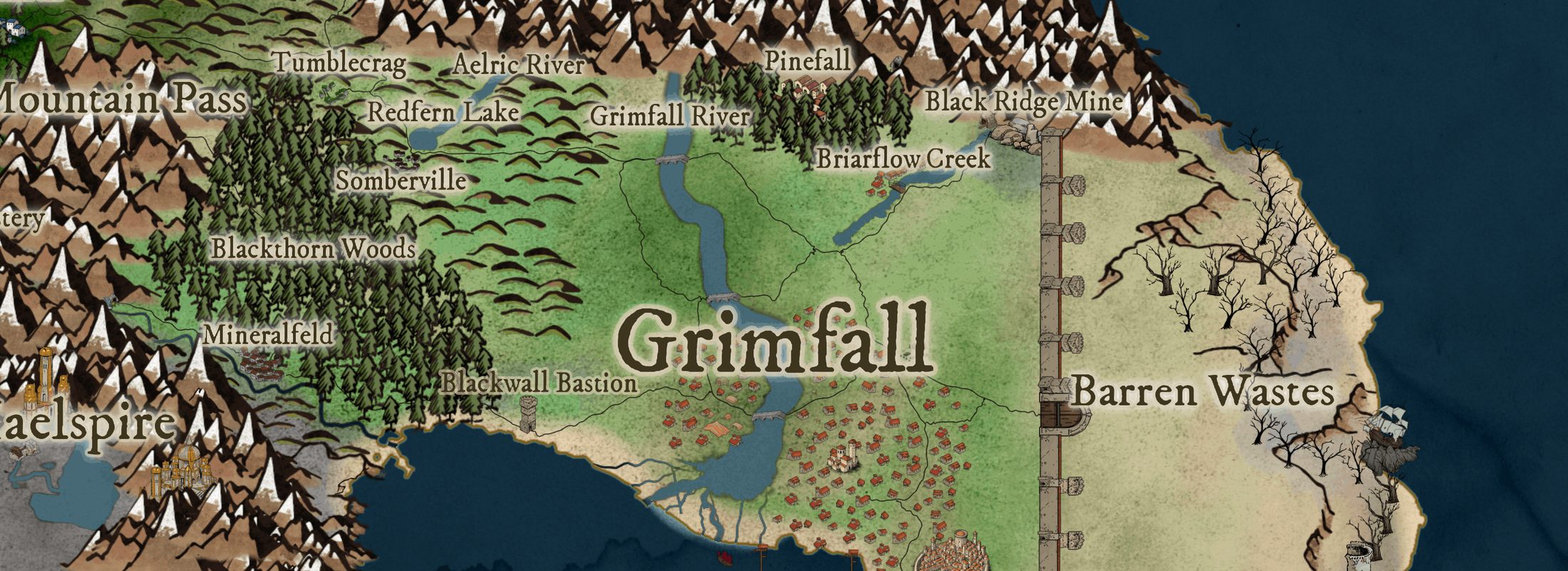
Grimfall and the southeastern territories · tap to enlarge
From the writings of Historian Calvess Marrin, 42nd Year After the War's End
Grimfall is built on industry, invention, and faith. Where Duskveil leans on magic, Grimfall relies on steel, smoke, and devotion. Its forges run day and night, crafting tools, weapons, and machines that rival anything arcana can produce. The clang of hammers and the scent of oil and coal define the city's rhythm.
Justice in Grimfall is neither quiet nor hidden. Criminals are cast into the Coliseum, where they fight for survival before crowds of thousands. The kingdom calls it trial by the gods. Some prisoners seize freedom through victory. Most do not survive.
Faith
Of the Three Kingdoms, none wears its faith as openly as Grimfall. The gods are invoked at every turn, in street sermons, in prayers before the Coliseum trials, in daily greetings exchanged between citizens. The people honor what they call simply "the Gods", divine figures whose true names were lost centuries ago. In Grimfall's churches, the gods are represented through abstract forms: silhouettes carved in stone, or idealized human figures, rendered without specificity.
Faith in Grimfall is communal and public by nature. To be faithful in Grimfall is to be seen in one's faith. Atheism is not a crime in Grimfall, but it carries severe social penalties. Those who openly reject the gods find themselves isolated. The exclusion is quiet but total.
Public questioning of the gods is far more dangerous. In 21 AE, an incident occurred during a church service in which a woman stood and declared that the gods were not real, that they had forsaken Grimfall and Atheron, and that the wars and famines proved their absence. The official account states that she became hysterical, drew a dagger, and stabbed herself more than sixty times before collapsing dead. Witnesses present claimed she had been possessed, that the gods themselves had turned her hand against her. The account is difficult to reconcile with the mechanics of self-inflicted injury. No investigation followed the incident, and the church's account became the accepted narrative.
Whether the gods acted that day, or whether the congregation did, is a question the records do not answer.
Justice by the Gods: The Judgment Stones
When an individual is convicted of a crime severe enough to warrant trial by the gods, they are brought to the floor of the Coliseum. There, in full view of the assembled crowd, they are presented with a plain wooden crate. The crate has a single opening at the top, and within it are four colored crystals. The prisoner must reach into the crate and draw one stone without looking. The draw is ceremony rather than chance. The High Arbiter determines the appropriate stone before the trial.
The Blue Stone is associated with lesser offenses: theft, trespassing, disorderly conduct. Survival is common, though not guaranteed. The Green Stone is drawn by those convicted of more serious crimes. The difficulty increases sharply, and fewer survive. The Red Stone corresponds to severe offenses. Those who draw it face creatures such as manticores or otyughs, beasts known for their lethality. Most who face Red Stone trials do not return. The Black Stone is reserved for the most grave crimes, including any involvement with the forbidden practice of artificery. To draw the Black Stone is to face certain death.
When the Black Stone is drawn, the prisoner does not face a beast. Instead, a fiendish entity appears, commonly referred to as the Executioner, and kills the prisoner swiftly. Witness accounts describe the creature as skeletal, silent, and methodical. It does not speak or hesitate. It appears, executes, and vanishes. Popular belief holds that it is bound by contract to the office of High Arbiter, though the nature of that contract and its terms are not matters of public record. Priests often invoke the Executioner in sermons as proof that even infernal powers can be turned to righteous ends, though theological consensus on this point is absent.
The announcer speaks the ritual phrase: "Speak your prayer. The gods will answer in blood or mercy." If the prisoner survives, they are immediately released. Their crime is considered absolved by divine judgment.
The Crisis of 1 AE
In the first year following the War's End, records show a marked shift in sentencing patterns under High Arbiter Corvin Thale. Prisoners who might previously have drawn Green Stones were instead assigned Blue. Grimfall's population had been devastated. Every life lost in the Coliseum was one fewer laborer, soldier, or parent.
Keeper of the Faith Yaelin Solm began preaching against what he called "false mercy." He argued that the Coliseum was a sacred institution, not just a legal one, a place where the gods themselves rendered judgment. Yaelin eventually brought his concerns directly to King Aelric Grimfall, demanding that Corvin Thale be removed from office. The King declined. Yaelin is recorded to have questioned the King's faith publicly, an act unprecedented and dangerous. King Aelric, in response, sentenced Yaelin Solm to trial by the gods.
Yaelin drew the Black Stone. The Executioner appeared as it always does, but instead of its usual swift dispatch, the creature prolonged Yaelin's death, tearing him apart slowly before the silent crowd. The message was unmistakable.
The immediate aftermath was chaos. Riots erupted throughout Grimfall City and spread to surrounding towns. The violence lasted several days. Buildings burned. Blood was shed. Once violence had ceased, the King addressed the kingdom publicly. He argued that the gods had chosen him to be King, and that the King, in turn, had chosen Corvin Thale to serve as High Arbiter. Therefore, the High Arbiter's decisions were extensions of divine will. Yaelin, by questioning that authority, had committed heresy. The argument was effective. The riots ceased.
Was Yaelin Solm a zealot whose rigidity endangered the kingdom, or a man of principle who died defending the gods' authority? The records do not provide clear answers.
Military & Defense
Grimfall maintains a disciplined standing army, focused not on conquest but on holding its territory and protecting its people. Military service is not mandatory for all citizens, unlike in Duskveil, but enlistment is common among the working class seeking steady pay and upward mobility. Grimfall's army values merit over birthright, no noble houses exist to claim hereditary command, and officers rise through competence and loyalty.
Since the Duskveil Wars, Grimfall has heavily expanded its naval armada, determined never again to be trapped by terrain or blockades. In emergencies, warships can be maneuvered upriver using reinforced channels and cleverly engineered levees, bringing heavy firepower directly to the capital's doorstep.
Grimfall maintains no standing adventurers guild. Anyone who wants to post a contract can; anyone who wants to take one does so at their own risk. There is no central registry, no ranking system, and no protection if a job goes wrong. The work gets done because someone is willing to do it for the coin.
Regions & Territory
Grimfall City
The city of Grimfall sits approximately 100 miles south of the mouth of the Grimfall River where it meets the southern ocean. Built on both banks and connected by fortified bridges, the city is a center of industry, faith, and martial culture. Population within the city proper exceeds fifteen thousand, with another ten to fifteen thousand living in surrounding settlements. The Coliseum dominates the southeastern district, its stone walls visible from much of the inner city.
Black Ridge Mine & Briarflow Creek
To the northeast, the Black Ridge Mine yields abundant iron ore, copper, and gemstones. The site has been worked for generations and shows no sign of exhaustion. The mine's production is transported south via Briarflow Creek, a river nearly a hundred miles long that flows through Grimfall's heartland. Barges carry ore downstream in steady streams, and the creek has become a vital trade artery.
The Barren Wastes & The Wall
To the east stretches the Barren Wastes, a desolate expanse of sand, rock, and death. During the Duskveil Wars, two war mages of legendary power met in combat east of Grimfall: Keistrim Firedeep, archmage of Grimfall, and Malrik Thorne, whose allegiance remains debated among scholars. Their duel annihilated miles of formerly fertile land, reducing fields and forests to ash and stone. The exchange killed both mages and left the region permanently scarred. To protect its heartland, Grimfall raised a wall fifty feet high and ten feet thick along the wastes' western edge. Elite soldiers are sometimes sent within as a test of strength and courage. The practice is dangerous, and many do not return, but those who do earn respect that few other achievements can match.
Blackwall Bastion
Guarding the western coast across the river from Grimfall City stands Blackwall Bastion, a coastal fortress built to repel invasion from the sea. If Grimfall's main harbor were ever blockaded or damaged, Blackwall Bastion could sustain naval operations independently for months.
Mineralfeld & Blackthorn Woods
West of Blackwall Bastion lies the village of Mineralfeld, a small community of perhaps three hundred inhabitants. To Mineralfeld's north stretch the Blackthorn Woods, a vast forest rich with game but stalked by predators and monsters. Wolves, bears, and more dangerous creatures claim the deeper regions, and those who venture too far often do not return. Adventurers frequently use the Blackthorn Woods as a proving ground, testing their skills against the forest's dangers before moving on to more lucrative or deadly contracts.
Pinefall
Directly north of Grimfall, near the confluence of Briarflow Creek and the main river, lies the town of Pinefall. Its population of approximately eight hundred lives primarily through mining, logging, and fishing. These waters are treacherous, claimed by merfolk and other sea-dwelling creatures that occasionally attack fishing vessels or drag sailors beneath the surface. The town was heavily damaged during the Duskveil Wars, burned during Duskveil's advance and abandoned for several years. Its recovery is a point of pride for Grimfall.
Somberville, Redfern Lake & Tumblecrag
Northwest of Grimfall, the town of Somberville sits beside Redfern Lake, where the Aelric River feeds cold alpine waters from the Veilrend Mountains. The land here is beautiful but haunted. The Battle of Redfern Lake, one of the war's bloodiest engagements, was fought on these fields and in these waters. Ghostly activity is frequently reported around the lake and in the surrounding fields. Witnesses describe phantom soldiers marching at dusk, voices heard across empty water, and lights that flicker where no fires burn. Further northwest lies Tumblecrag, a town of roughly six hundred known for its unique pheasant, a prized delicacy throughout Atheron. The birds are raised locally and exported across the continent, making Tumblecrag wealthier than its size would suggest.
The Mountain Pass
Cutting through the mountains between Grimfall and Velgrada, this pass belongs to neither kingdom. The journey spans over a hundred miles of rough, narrow terrain wholly unsuited for caravans or large groups. Dire wolves, bears, and worse stalk the heights, and the weather can turn lethal without warning. For military purposes, the pass is irrelevant. No army could march through it in meaningful numbers.
Public Figures
Former King Aelric Grimfall
Appearance: A very large, old man still riddled with muscle despite his years. His skin is tan and leathery, as though weathered by long days in the sun. He carries the weight of everything that happened during the Duskveil Wars, mentally checked out, with a distant thousand-yard stare.
Aelric Grimfall is a figure of respect and tragedy. He ruled Grimfall during its darkest hours, the Duskveil Wars, and bore the weight of decisions that cost thousands of lives. His only daughter, Princess Elowen, married Prince Vaerion Duskveil in a failed attempt at reconciliation between the warring houses. When Vaerion was assassinated and Elowen died of illness during the Famine Years, Aelric took in their infant son, Alvaron, raising him as both grandson and heir. In 40 AE, at the age of 77, Aelric abdicated the throne to Alvaron. Since his abdication, the former king has withdrawn from public life.
King Alvaron Duskfall
Appearance: Long brown hair and a full beard, with a heavy-set brow and a prominent forehead. His deep brown eyes always look faintly sad, as if he unintentionally feels sorry for you, though never in a condescending way.
King Alvaron Duskfall rules Grimfall as the son of two bloodlines. His father, Prince Vaerion Duskveil, was assassinated at his wedding before Alvaron's birth. His mother, Lady Elowen Grimfall, died when he was young. His claim to the throne unites the bloodlines of both Duskveil and Grimfall, a fact that has shaped his reign. Some view him as a symbol of reconciliation between the warring kingdoms. Others regard him with suspicion, questioning where his true loyalties lie. At his christening, Lady Elowen declared him Alvaron Duskfall. Grimfall's nobility, however, refer to him in council and formal record as Alvaron Grimveil. Both names persist, their usage often reflecting the speaker's political leanings.
Queen Serenth Velgrada Duskfall
Appearance: Stern and motherly, with an almost constant scowl, a reflection of how little she trusts those she doesn't know well. She usually carries a hidden dagger and shortsword, which only the sharp-eyed will notice.
Queen Serenth was born into a respected Velgradan noble line and received training uncommon for most nobility. She studied diplomacy, martial skills, and what some describe as the subtler arts practiced among Velgrada's elite. Publicly, Queen Serenth is gracious and soft-spoken, a figure favored in Grimfall's court for her kindness and composure. Whispers persist that her loyalties remain divided between her Velgradan blood and her Grimfall crown. To some she represents a bridge between nations; to others, a reminder that Grimfall's throne carries foreign heritage.
Prince Eryc Duskfall
Appearance: Thin and tall, with a gaunt but handsome face and curly brown hair. He wears glasses, which he's self-conscious about.
Prince Eryc Duskfall is the eldest son of King Alvaron and Queen Serenth, groomed from birth as heir to Grimfall's throne. Unlike his younger brother Vaelor, Eryc is not celebrated as a warrior. His strengths lie in policy, economics, and diplomacy. Some nobles whisper that Eryc lacks the fire necessary to rule a martial kingdom like Grimfall. Others argue that his restraint and intellect are precisely what Grimfall needs after decades of war and recovery.
Prince Vaelor Duskfall
Appearance: Tall, dark, and handsome, the picture of "the perfect guy": charming, funny, and effortlessly approachable.
Prince Vaelor Duskfall is Grimfall's favored son in the eyes of the common people. A capable warrior trained in the sword and daggers, he has fought publicly in the Coliseum since the age of nineteen. His performances draw massive crowds, and he has yet to suffer a public defeat. Vaelor first became a public figure at age twelve following an incident in which he defended himself against an assailant within the palace. Official accounts describe the encounter as successful self-defense, and the event established his reputation as blessed by the gods. Despite being the younger son, Vaelor's public profile often overshadows his brother's, though court observers note that the brothers appear genuinely close.
High Arbiter Malgor Zyne
Appearance: A man on the plumper side, balding with a bit of hair left on his head. His round face has a calming quality, like a kind, reassuring uncle. Soft-spoken, with a voice that soothes those he speaks to personally.
High Arbiter Malgor Zyne oversees Grimfall's system of divine justice, presiding over trials in the Coliseum where guilt and innocence are determined by combat. He has held the office for nearly three decades, longer than any High Arbiter in recent memory. He resumed strict enforcement of sentencing guidelines in 21 AE following the Hetaran Gorefief case, ending a period of leniency that had persisted since the war's end. Grimfall's people trust Malgor to uphold the will of the gods, and his reputation for integrity has never been publicly questioned.
Keeper of the Faith Frel Vizeo
Appearance: Average build and height, with kind eyes and a faint, ever-present smile. Charming, charismatic, and extremely approachable.
Frel Vizeo serves as Grimfall's Keeper of the Faith. Unlike more reclusive religious figures in other kingdoms, Frel walks the streets of Grimfall openly, greets citizens by name, and offers blessings freely. He serves as spiritual advisor to King Alvaron and leads prayers for the royal family during formal occasions. His approachability has made him a beloved figure.
Captain Corrick Swiftblade
Appearance: Lean and athletic with short dark hair and a tan complexion. He wears clean leather armor with metal plating over the vital areas and is always armed with a rapier and dagger.
Captain Corrick Swiftblade is the youngest individual to hold the position of Captain of the Guard in Grimfall's recorded history. He assumed the role in 40 AE at age twenty-seven, having joined the military at fifteen. Corrick favors mobility and precision over brute force, a fighting style that has earned him the moniker "Swiftblade." The name was reportedly earned during his service and adopted formally as his surname, though records of his birth name are not commonly referenced in public documents. His effectiveness in the role has silenced early skepticism about his appointment.
Crest & Meaning
The chained kraken represents Grimfall's claim of mastery over chaos and the sea, a projection of strength that the Encircling Ocean has repeatedly disproven. The Maelspire Expedition's failure and the loss of nearly one thousand sailors serve as grim reminders that the ocean remains unconquered. Grimfall chains a kraken on its banner while its sailors avoid open water. Grimfall is only as powerful as its ability to maintain control, and the sea has never been controlled.